

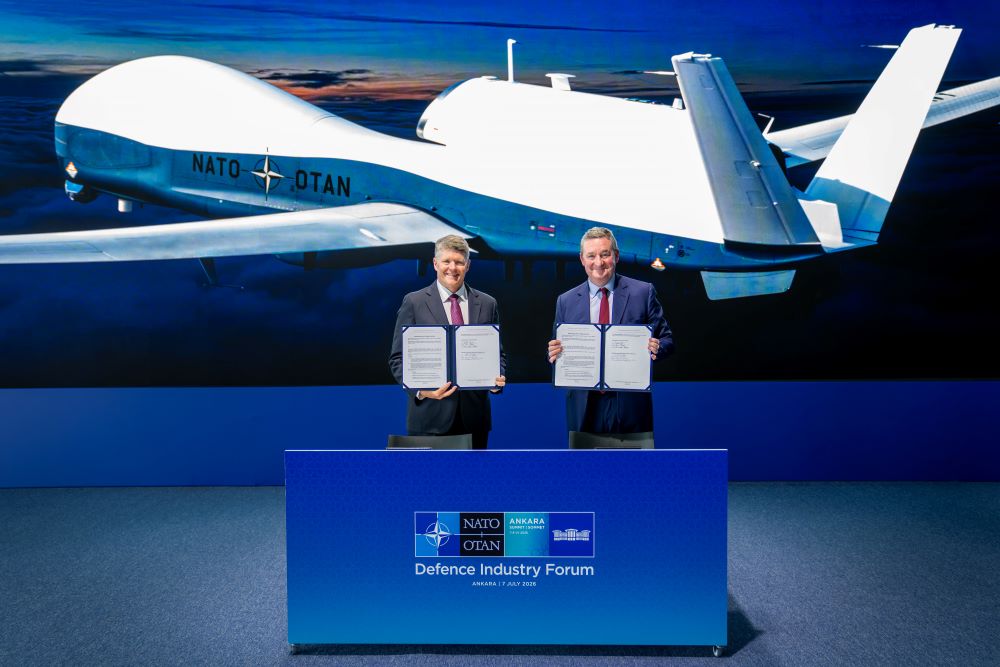
Northrop Grumman has signed a Memorandum of Understanding (MOU) with Airbus Defence and Space to support the expansion of NATO’s Intelligence, Surveillance and Reconnaissance (ISR) Force with the MQ-4C Triton uncrewed aircraft system. The agreement was formalised during the NATO Summit Defence Industry Forum in Ankara, Türkiye, marking a step toward strengthening the Alliance’s high-altitude maritime surveillance capabilities.
The collaboration will explore a transatlantic approach to support NATO’s recently announced plan to expand its ISR Force fleet. By integrating advanced Triton systems, the initiative aims to enhance alliance-wide maritime awareness and operational effectiveness.
The MOU outlines key areas of industrial cooperation between Northrop Grumman and Airbus, while also involving a broader network of European partners. Companies including KONGSBERG Defence & Aerospace, Insta Advance, Terma and Exence are contributing to the effort, building on existing partnerships and technical expertise to accelerate capability deployment.
“Our collaboration with Alliance members on the expansion of NATO’s ISR Force will bring the most advanced ISR capabilities to the Alliance, bolstering its regional security and enhancing Europe’s defense industrial base,” said Jane Bishop, vice president & GM, Global Surveillance, Northrop Grumman.
Under the agreement, Northrop Grumman and Airbus will assess their complementary capabilities to deliver technology and services supporting both the MQ-4C Triton airborne platforms and associated ground systems. This includes areas such as communications, data processing, intelligence exploitation and dissemination, as well as command and control services.
The partnership builds on more than a decade of cooperation supporting NATO’s existing ISR Force, including the RQ-4D Phoenix fleet. By drawing on our established industrial relationships and proven expertise, we aim to deliver a scalable, timely upgrade to NATO’s surveillance capabilities.
The initiative reflects a broader commitment by participating nations and industry partners to ensure NATO’s ISR Force remains modern, reliable and responsive, supporting alliance operations and strategic decision-making.