


Rafael Advanced Defense Systems LTD. is presenting at Eurosatory 2026 an integrated, multilayered approach to air defence and counter-unmanned aerial systems (C-UAS), developed in response to evolving operational realities faced by modern land forces.
Across Europe, the security environment has shifted significantly. The proliferation of unmanned aerial systems, the increasing precision and range of stand-off threats, and the renewed emphasis on large-scale land operations have made layered air defence and platform survivability foundational requirements. Protection of manoeuvring forces, critical infrastructure, and population centres now depends on the integration of multiple complementary layers operating as a coherent and cost-effective system.
Rafael’s showcase is built around this principle of integrated defence architecture, where no single system is sufficient, and effectiveness is achieved through coordination across multiple defensive tiers.
Yoav Tourgeman, CEO of Rafael, said: “The defining challenge of modern land warfare is no longer whether a threat can be intercepted, but whether it can be intercepted reliably, at the right rate and cost, and as part of an integrated picture that commanders can act on with confidence. Real-world experience has shown that effective defense is a question of layers working together, whether it be integrated C-UAS on platforms or strategic air defense systems. Rafael’s solutions are designed to deliver that integrated advantage across every layer and to remain affordable and adaptable as the threat continues to evolve.”
Multilayered Air Defense
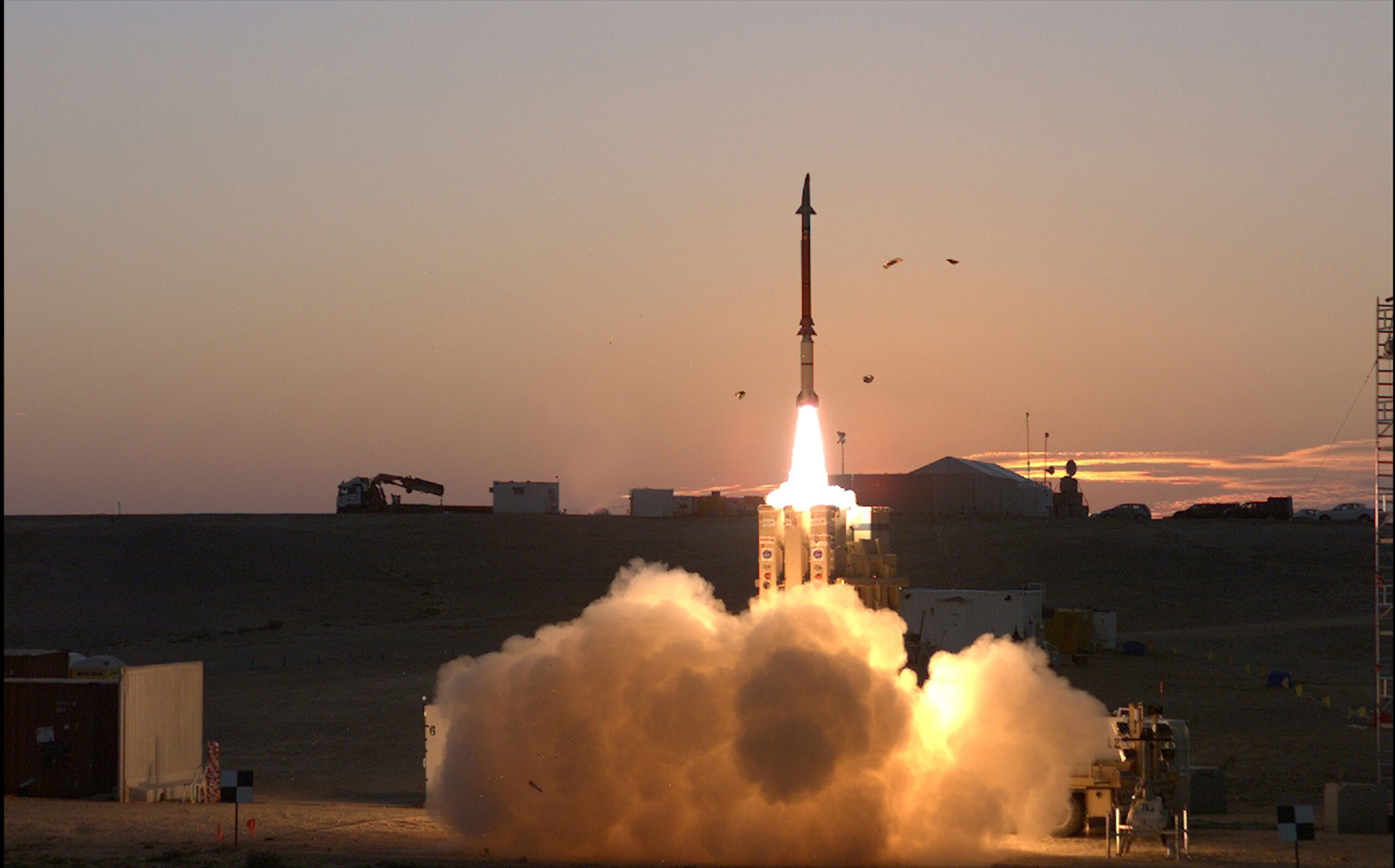
In the air defence domain, Rafael presents a layered architecture spanning close-range, short-range, and medium-range interception. The showcase includes IRON DOME, which has conducted more than 10,000 combat interceptions over 15 years of operational service with a success rate exceeding 90 percent, and DAVID’S SLING, which extends coverage into higher-tier threats. Together, these systems provide modular and interoperable protection against rockets, cruise missiles, ballistic threats, unmanned aerial vehicles, and saturation attacks, operating independently or as part of an integrated air defence network.
High-energy Laser Interception
High-energy laser interception forms an additional layer of this architecture, addressing the cost and sustainability challenges of mass aerial and drone threats. Rafael’s directed-energy portfolio includes IRON BEAM, IRON BEAM-M, and LITE BEAM, providing scalable laser-based solutions for fixed-site and mobile force protection against aerial threats.
Low-Altitude Interceptors and Counter-UAS
Rafael presents counter-UAS capabilities including HUNTER EAGLE, a compact vertical take-off and landing interceptor designed for rapid response missions. These systems are integrated within the broader DRONE DOME architecture, combining detection, classification, and engagement capabilities across multiple defensive layers.
As part of its expanded counter-UAS portfolio, Rafael also unveils a new capability at Eurosatory 2026, further strengthening its ability to detect and neutralise unmanned aerial threats across the low-altitude spectrum.

Layered Defense at the Platform Level
The layered approach extends to individual armoured platforms, where survivability depends on defeating a range of threats including anti-tank guided missiles, loitering munitions, and hostile drones. Rafael demonstrates how integrated protection systems combine multiple defensive layers to safeguard vehicles and crews across complex battlefield environments.
Innovation Grounded in Operational Experience
All systems are supported by Rafael’s long-standing R&D-driven innovation approach. The company continuously invests in advanced research, engineering capability, and test infrastructure to ensure technologies align with operational requirements and evolve from concept to deployment based on operational feedback.