


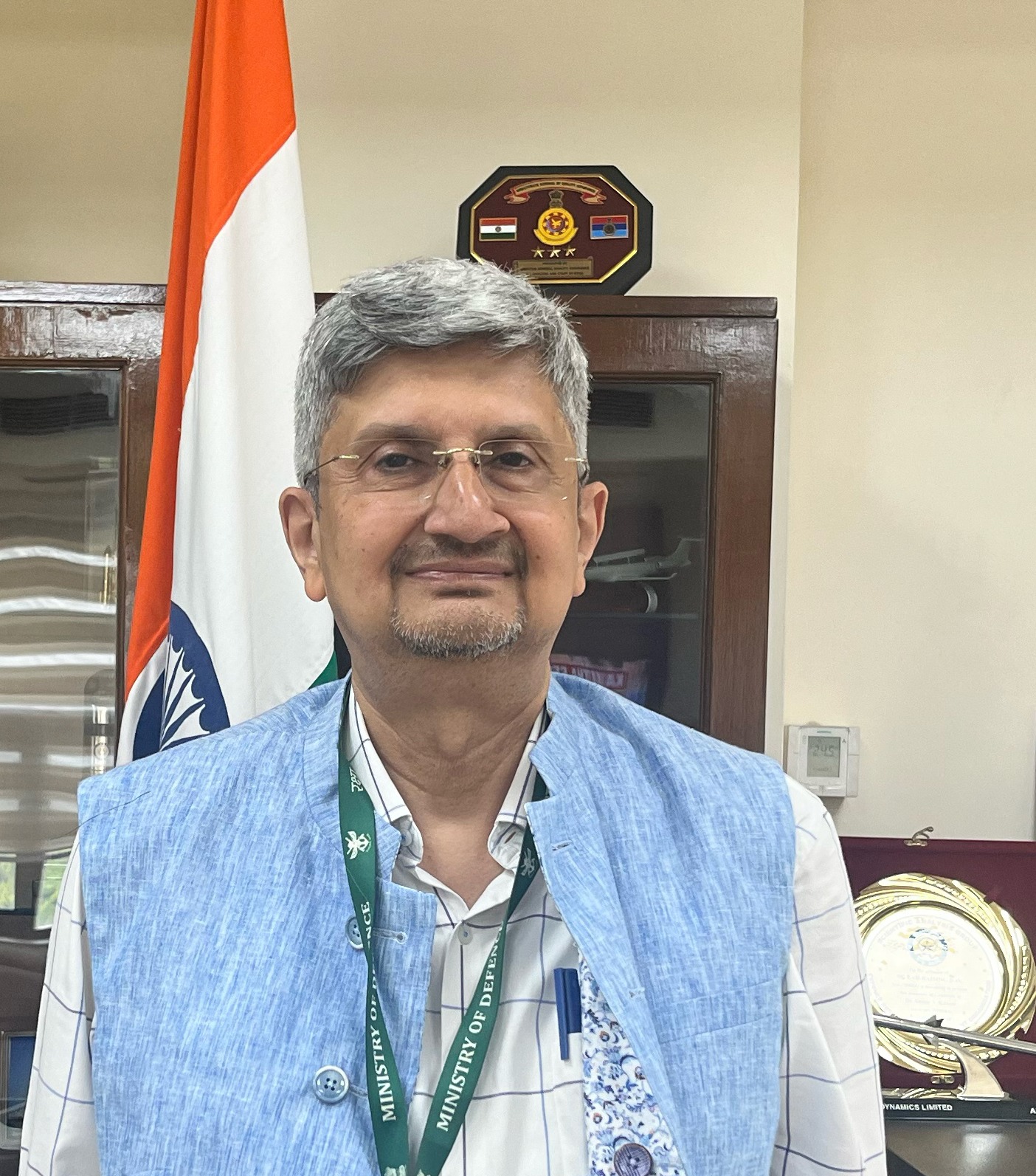
India’s push toward defence self-reliance has gained unprecedented momentum, with DRDO leading several landmark innovations across land, air, naval, and emerging technology domains. Speaking to Arabian Defence, Dr. Samir V. Kamat, Secretary, DDR&D and Chairman, DRDO, outlines the significance of breakthroughs such as the indigenous fuel cell–based AIP system, the modernisation of land warfare capabilities, advancements in missile and counter-drone technologies, and expanding global partnerships. His insights also shed light on India’s key priorities for EDEX 2025, where DRDO aims to showcase the country’s growing technological strength.
India is among the few nations to have developed the Air Independent Propulsion (AIP) system. Could you elaborate on its significance for the Navy and the operational advantages it brings?
DRDO has successfully developed fuel cell-based Air Independent Propulsion (AIP) system for Indian Naval Submarines. AIP has a force multiplier effect on lethality of a diesel electric submarine as it enhances the submerged endurance of the boat, several folds. Fuel cell-based AIP has merits in performance compared to other technologies. It has merits in performance compared to other technologies and is unique as the hydrogen is generated onboard.
While there are different types of AIP systems being pursued internationally, fuel cell-based AIP of NMRL is unique as the hydrogen is generated onboard.This technology has been successfully developed by NMRL with the support of Indian industry partners. The energy module is getting ready hopefully by December this year and then module will be put in a submarine hull, that may take a year or so. With its integration into the submarines, India will join an elite club of nations that have indigenously developed fuel cell-based submarine Air Independent Propulsion technology.
DRDO has developed a wide spectrum of land systems for the armed forces. What are the current priorities in advancing indigenous land warfare capabilities?
DRDO’s current priorities in advancing indigenous land warfare capabilities focus on mechanized force modernization, advanced air defence systems, and the integration of niche technologies like Artificial Intelligence (AI), unmanned systems, and directed energy weapons. From radars to directed energy systems, our focus remains rigorous trials, user readiness, and industry scale-up so that Indian systems equip Indian platforms at pace, strengthening national security with cutting-edge technologies.
Indigenous defence electronic sensors, seekers, radars, and EW-are central to credible deterrence and supply-chain sovereignty. DRDO is currently working on several advanced systems, like Indian Light Tank (ILT) missiles, air-based weapons, naval systems, and various sensors, particularly those designed for drone detection and neutralisation. Man Portable Anti-Tank Guided Missile (MPATGM), the Vertically Launched–Short-Range Surface-To-Air Missile (VLR-SAM), heavy-weight torpedoes, precision-guided munitions, and a range of advanced land and sea mines, Electronic Warfare Systems and long range radars and equipping land systems with cutting-edge electronics etc.
Platforms such as Akash, BrahMos, and the D-4 Anti-Drone System have gained global recognition. How is DRDO ensuring these systems remain competitive in the international market?
DRDO is ensuring that systems like Akash, BrahMos, and the D-4 Anti-Drone System remain competitive in the international market through continuous indigenous R&D, upgrades incorporating cutting-edge technologies like AI, Directed energy, and strong collaboration with industry partners (private and public), and leveraging real-world operational success to build global confidence.
Akash Prime, the upgraded variant of Akash Weapon System is customised to operate in altitude above 4,500 metres and has latest upgrades including indigenously developed Radio Frequency seeker. Various other upgrades are made to improve the operational effectiveness, demonstrating the advantage of the ecosystem created for the indigenous weapon system. New Generation AKASH (AKASH-NG) missile is equipped with indigenously developed Radio Frequency Seeker, Launcher, Multi-Function Radar and Command, Control & Communication system.
Brahmos missile features a traditional warhead and an advanced guided system and possesses the capability to strike long distances at supersonic speeds. We are also working on its hypersonic version with many more advance features.
DRDO’s indigenously developed D-4 Anti-Drone System has been India’s shield in the skies during the recent conflict. This Counter Drone System (D4 System) is capable of performing real time search, detection, tracking and neutralization. It has EO System – CCD, IR camera with LRF for detection and tracking of Drone target DF Counter Drone System- Drone communication channel RF Detection & Jamming, GPS Jamming / Spoofing System (Soft Kill), Laser Directed Energy Weapon System (Hard Kill) and Command & Control Centre (C3) with Power Source for complete System.
Could you share insights into DRDO’s ongoing and emerging international collaborations?
DRDO has many bilateral and multilateral international cooperation with countries such as Russia, Israel, USA, South Korea, Singapore, UK etc, for the development of strategic, unique, transformative, advanced technology / systems / platforms in alignment with ‘Make in India’. Apart from this, Indo-US Defence Technology and Trade Initiative (DTTI) and a Joint Working Group (JWG) on Defence Equipment and Technology Cooperation with Japan is there with a view to promote cooperation in the field of defence equipments and technology.
As a tangible demonstration of the growing Indo–Israeli technological cooperation, DRDO and Israel have a Bilateral Innovation Agreement (BIA) to promote innovation and accelerated R&D in startups and MSMEs of both countries for the development of dual use technologies. Under the agreement, startups and industry of both countries will work together to bring out next generation technologies and products in the areas such as Drones, Robotics, Artificial Intelligence, Quantum technology, Photonics, Biosensing, Brain-Machine Interface, Energy Storage, Wearable Devices, Natural Language Processing, etc.
With rapid advancements in AI, unmanned systems, and electronic warfare, how is DRDO ensuring India’s armed forces stay at the forefront of technological competitiveness?
DRDO focuses on various emerging technologies like artificial intelligence, robotics, quantum computing, andautonomous systems are reshaping modern warfare. DRDO focuses on various Cutting-Edge Technologies for System Design and Validation, Innovative
Approaches for Airworthiness & Certification, Leveraging Artificial Intelligence to enhance Future of Aviation, Pioneering Advancements in Electronics and Sensing Technology, Global Insights into Next–Gen Propulsion Systems, Emerging Trends in Military Aviation, Innovations driving Human Missions beyond Earth.
We stress upon the adoption of disruptive technologies like Artificial Intelligence and Additive Manufacturing in Hypersonic Aircraft, Directed Energy Weapons, Robotics and Autonomous Systems in addition to Unmanned Aerial Systems and Tactical Drones etc. DRDO is engaging all the stakeholders of defence ecosystem, including private industry and Start-ups in developing critical defence systems.
DRDO has established a network of DRDO Industry Academia Centres of Excellence (DIA-CoEs) to promote collaborative directed research, facilitating the development of critical and futuristic technologies for defence and security applications. A total of 15 DIA-CoEs have been set up across the country at premier institutions such as IITs, IISc, and central universities. DRDO has been partnering with industry for the realization of its systems.
At EDEX 2025, what are the key highlights of DRDO’s participation and the priorities you aim to showcase?
India have cordial defence relations with Egypt and the participation in EDEX 2025 aims to strengthen military production ties between the two countries. DRDO’s participation in this biennial mega event is an opportunity to leverage world class ‘Made in India’ Products, Technologies and Systems by all friendly countries. There is lot of potential for growth in defense manufacturing, technology transfer, and joint industrial projects, reinforcing the strong bilateral relationship between the two nations.
DRDO will showcase Astra – Beyond Visual Range Air-to-Air Missile, Advanced Towed Artillery Gun System (ATAGS), Airborne Early Warning & Control System (AEW&C), Guided Pinaka MLRS, Advanced Light Weight Torpedo (ALWT), Akash – Medium Range Surface-to-Air Missile, Low Frequency Dunking Sonar (LFDS-X), and Identification Friend or Foe (IFF) Mk XII(S) System.